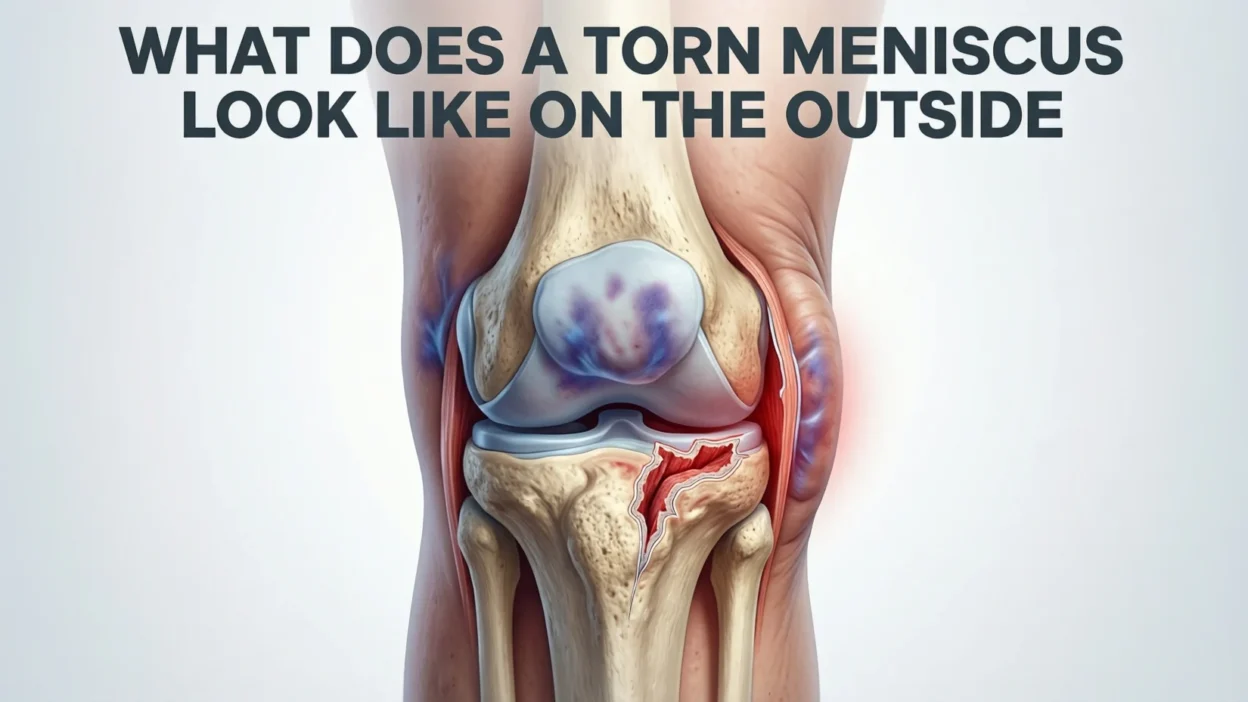
The first time I heard someone say their meniscus was torn, it was after a soccer game. They were limping and holding their knee, and someone in the group chat commented, “bet it’s a torn meniscus.
” At first, I imagined the knee looking deformed or having huge bruises, but I quickly realized that unlike cuts or sprains, a torn meniscus doesn’t always show obvious signs on the outside.
If you’ve ever wondered, “what does a torn meniscus look like externally?”, this guide will explain it in clear, simple terms.
Quick Answer:
A torn meniscus usually doesn’t show dramatic changes on the outside, but mild swelling, bruising, or stiffness around the knee can appear.
What Is a Torn Meniscus?
Full form:
There’s no abbreviation; a meniscus is a C-shaped piece of cartilage in the knee that cushions the joint and stabilizes movement.
Plain-English meaning:
A torn meniscus happens when this cartilage is damaged, usually from twisting the knee or sudden impact. This can occur in sports, heavy lifting, or even normal wear and tear in older adults.
Why people check for visual signs:
Unlike open injuries, a torn meniscus is mostly internal, so people often want to know if it’s noticeable on the outside without a doctor’s exam.
Example sentence:
“after twisting my knee, it swelled a little, and i think it’s a torn meniscus.”
Bold summary:
A torn meniscus is mostly internal, so outside signs are subtle, usually swelling, mild bruising, or stiffness.
Where Is the Meniscus in the Knee?
The meniscus is located between the thigh bone (femur) and shin bone (tibia):
- Inner part of the knee – medial meniscus
- Outer part of the knee – lateral meniscus
A tear can happen on either side, affecting stability and causing pain, but usually no external deformation is visible.
What a Torn Meniscus Can Look Like on the Outside
Although the meniscus is inside the knee, some external clues can suggest a tear:
- Mild Swelling
- Appears a few hours after injury
- Can make the knee look slightly puffy
- Bruising
- Occasionally develops around the joint
- Usually mild unless combined with other injuries
- Stiffness or Slight Redness
- The knee may feel tight
- The skin can look slightly reddish due to inflammation
- Limited Movement or Wobbling
- Not visible exactly, but the knee may look bent awkwardly when the person avoids putting weight
Important note:
A torn meniscus rarely produces a visible cut, deformity, or large bump. Pain, locking, or clicking inside the knee is more telling than appearance.
Signs and Symptoms You Can See or Feel
Even if it doesn’t “look” dramatic, these signs are common:
- Swelling near the joint
- Slight bruising on the inner or outer knee
- Knee looks puffy compared to the other knee
- Difficulty straightening or bending the knee
- Limping or uneven walking
These clues are often subtle, so comparison with the healthy knee helps.
Realistic Conversation Examples (Text Style)
- “my knee is a bit swollen, could it be a torn meniscus?”
- “no big bruise, just stiffness”
- “it feels like it locks sometimes”
- “swelling came a few hours after soccer”
- “kneecap looks normal but hurts inside”
- “doc says torn meniscus, barely any visible signs”
- “i can’t fully bend my knee”
- “just mild redness and puffiness”
When to Be Concerned (Do & Don’t)
✅ Do:
- consult a doctor if swelling or pain persists
- get an MRI if movement is limited
- rest and avoid twisting the knee
- ice and elevate the knee initially
- consider seeing a physiotherapist
❌ Don’t:
- ignore persistent pain
- keep playing sports on the injured knee
- assume no visible signs mean no injury
- self-diagnose without medical imaging
Small Comparison Table
| Symptom | External Appearance | Why It Matters |
|---|---|---|
| mild swelling | knee slightly puffy | possible tear |
| redness | subtle skin inflammation | irritation inside |
| bruising | rare or minor | could indicate more damage |
| deformity | none | meniscus tear is mostly internal |
| locking | awkward bending | classic internal symptom |
Conditions Often Confused with Torn Meniscus
- Knee sprain – ligament-related, can cause more swelling
- Patellar injury – kneecap injuries may look more pronounced
- Bursitis – visible swelling at front or side of knee
- Ligament tear (ACL/MCL) – often more instability than meniscus
- Arthritis – swelling but gradual onset, usually bilateral
A meniscus tear is mostly internal—so external signs are subtle.
FAQs About “What Does a Torn Meniscus Look Like on the Outside?”
1. Can a torn meniscus cause visible swelling?
Yes, mild swelling is common, but it’s usually subtle.
2. Will I see bruising?
Sometimes, but not always. It’s more common with other injuries.
3. Does the knee look deformed?
No, a torn meniscus usually doesn’t change the shape of the knee.
4. Can you tell a meniscus tear without an MRI?
External signs help, but an MRI or professional exam is needed for confirmation.
5. Does the knee look red?
Occasionally, due to inflammation, but it’s usually faint.
6. Can the knee lock or bend strangely?
Yes, internal catching or locking is a common sign, even if it looks normal externally.
7. Is swelling the only clue?
Mostly yes. Pain, stiffness, and limited motion are more reliable than appearance.
Final Thoughts
So, what does a torn meniscus look like on the outside?
Mostly, it doesn’t look dramatic externally.
You may see mild swelling, slight bruising, or redness, but the real symptoms—pain, locking, clicking, or limited movement—come from inside the joint.
Understanding these subtle clues helps you know when to seek medical attention even if the knee looks mostly normal. Remember, a torn meniscus is an internal injury, and early diagnosis and care are important for recovery.