Introduction
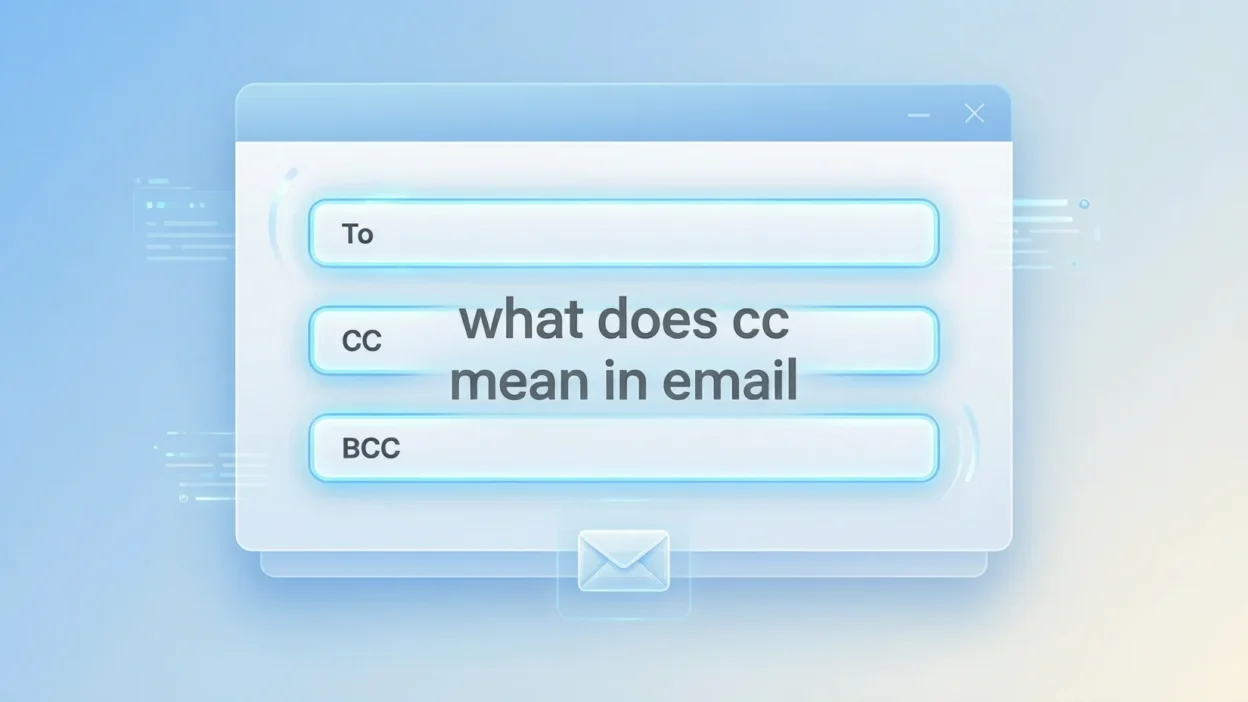
You’re sending an email, and right under the To field you see something called CC. Maybe you’ve used it before. Maybe you’ve ignored it completely.
Or maybe someone once said, “I’ll CC you on that,” and you nodded like you understood—while secretly wondering what it actually meant. If you’ve ever felt unsure about when or why people use it, you’re not alone.
Email has its own little rules, and CC is one of the most common (and confusing) parts. So let’s clear it up once and for all.
Quick Answer:
CC in email stands for carbon copy and is used to send a copy of an email to additional people who should see the message but are not the main recipient.
What Does CC Mean in Email? (Meaning Explained Simply)
CC is an email feature that lets you include extra people in a conversation.
Full form
- CC = Carbon Copy
The term comes from old-school paper letters, where carbon paper was used to make copies of the same message.
Plain-English explanation
When you CC someone:
- they receive the email
- they can see who else got it
- they are included for awareness, not action
They’re basically being kept in the loop.
Why people use CC
People use CC because it:
- keeps others informed
- adds transparency
- avoids forwarding emails later
- shows shared communication
One short example sentence
- i’m cc’ing my manager so they’re aware.
Bold summary: CC means carbon copy and is used to include others in an email for information, not direct response.
Where Is CC Commonly Used?
You’ll see CC mostly in professional and semi-formal email communication.
Common places CC is used:
- work and office emails
- school or university emails
- client communications
- project updates
- group coordination messages
Tone and formality
- Tone: neutral
- Formality: professional to semi-formal
CC is normal in business emails but less common in casual personal emails.
Realistic Email Examples (Simple and Clear)
Here are 8 realistic examples of how CC is used in emails:
- cc’ing finance for visibility
- i’ve cc’d the team for reference
- adding hr in cc
- looping you in via cc
- cc’d my supervisor on this email
- keeping legal in cc just in case
- cc so everyone stays aligned
- i’ll cc you when i reply
These examples show awareness-based usage, not commands.
When to Use and When NOT to Use CC
Using CC the right way matters for email etiquette.
✅ Do use CC when:
- someone needs information but not action
- multiple people should see the update
- transparency is important
- documenting communication matters
❌ Don’t use CC when:
- the person needs to take action (use To)
- the information is private
- you’re trying to pressure someone
- it could create confusion
Context comparison table
| Context | Example Phrase | Why It Works / Doesn’t |
|---|---|---|
| project update | cc’ing the team | keeps everyone informed |
| manager visibility | cc my manager | transparency |
| private feedback | cc everyone | inappropriate |
| action request | cc instead of to | unclear responsibility |
CC vs BCC (Common Confusion)
Many people mix these up, so here’s a simple comparison:
| Feature | CC | BCC |
|---|---|---|
| visible recipients | yes | no |
| transparency | high | hidden |
| common use | awareness | privacy |
| etiquette level | professional | sensitive cases |
- CC = everyone can see who’s included
- BCC = recipients are hidden from each other
Why CC Matters in Professional Emails
Using CC correctly:
- avoids misunderstandings
- creates accountability
- saves time
- shows professionalism
Overusing CC, however, can:
- clutter inboxes
- annoy coworkers
- reduce clarity
Balance is key.
Similar Email Terms You Should Know
Here are related email terms often used with CC:
| Term | Meaning | When Used |
|---|---|---|
| to | main recipient | action required |
| bcc | blind carbon copy | privacy |
| reply all | responds to all recipients | group replies |
| forward | sends email to new people | sharing info |
| loop in | informal way to say cc | work emails |
Knowing these helps you sound confident in email communication.
FAQs About CC in Email
1. what does cc mean in email?
It means carbon copy and sends the email to additional recipients.
2. should cc recipients reply?
Usually no, unless they have something relevant to add.
3. is cc rude?
No, but overusing it can be annoying.
4. can everyone see who is cc’d?
Yes, all recipients can see CC addresses.
5. should i cc my boss?
Only if they need visibility or awareness.
6. is cc formal?
It’s neutral and commonly used in professional settings.
Final Thoughts
So, what does CC mean in email? It stands for carbon copy and helps keep people informed without making them responsible for responding. When used correctly, CC improves clarity, transparency, and teamwork.
When overused, it clutters inboxes. The key is simple: use CC for awareness, not action. Once you understand that rule, email communication becomes much easier—and more professional.