Introduction
The first time most people see the word congruent, it’s usually in a math class, written on a board with shapes and angles.
Or maybe you spotted it in a tweet, article, or self-help post saying something like, “your actions should be congruent with your values.”
And suddenly you’re thinking — wait, does this mean “same”? “Similar”? Or something deeper?
Don’t worry. You’re not alone. Congruent is one of those words that sounds complicated but is actually very simple once you break it down. Let’s make it clear, relatable, and easy to remember.
Quick Answer:
Congruent means matching exactly or being in agreement with something else.
What Does Congruent Mean? (Plain English Breakdown)
Full meaning
The word congruent comes from Latin congruere, meaning to agree or fit together.
In simple terms:
How it’s commonly used
The meaning slightly changes depending on the context, but the core idea stays the same.
- In math → shapes that are the same size and shape
- In language or life → actions, words, or ideas that agree with each other
One short example
- His words were congruent with his actions.
That means what he said matched what he did.
Bold summary:
Congruent means perfectly matching or being in agreement.
Where Is the Term Congruent Commonly Used?
The word congruent shows up in more places than you might expect.
1. Math and geometry
This is where most people first learn it.
- congruent triangles
- congruent angles
- congruent shapes
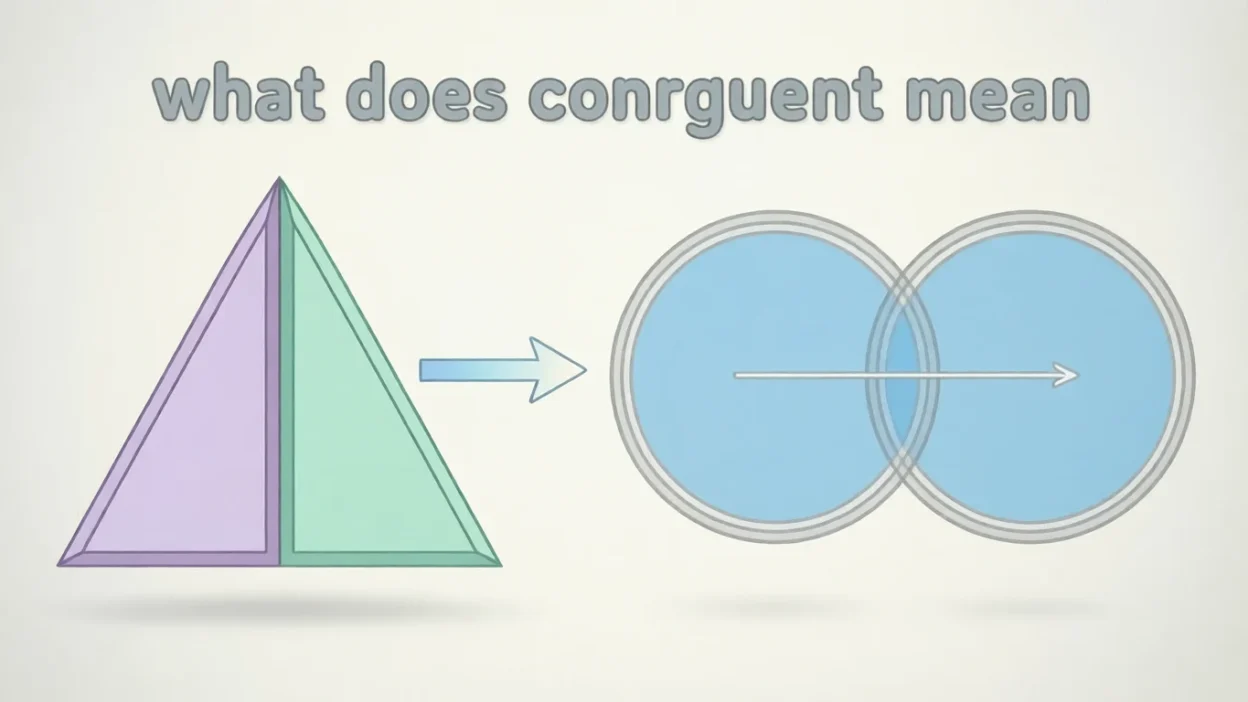
Here, it means exactly the same size and shape, even if rotated or flipped.
2. Psychology and self-help
Used to describe inner alignment.
- thoughts congruent with feelings
- actions congruent with values
This usage is very common in motivational content.
3. Professional and academic writing
You’ll see it in:
- essays
- research papers
- workplace communication
4. Online discussions and social media
It’s less slangy, but still used:
- in thoughtful posts
- in debates
- in comment sections
Tone:
The word congruent is generally neutral to formal, not casual slang.
Congruent in Math (Super Simple Explanation)
In math, congruent has a very specific meaning.
Congruent shapes are:
- the same size
- the same shape
- equal in angles and sides
They can be:
- rotated
- flipped
- moved
As long as they match exactly, they’re congruent.
Example
Two triangles with the same side lengths and angles are congruent — even if one is upside down.
Math summary:
Congruent shapes = identical in size and shape.
Realistic Conversation Examples (Modern Style)
Here’s how congruent might appear in real conversations online or in writing:
- your actions aren’t congruent with what you’re saying
- that advice isn’t congruent with reality
- i want a life that’s congruent with my values
- his apology felt congruent, not forced
- the brand message isn’t congruent with their behavior
- your logic is congruent, i get it now
- being congruent matters more than being perfect
These are natural, realistic uses — especially in thoughtful discussions.
When to Use and When NOT to Use Congruent
✅ When to use congruent
- when talking about matching ideas
- when describing alignment
- in math or academic contexts
- in professional or thoughtful writing
❌ When not to use congruent
- in very casual texting
- in jokes or slang-heavy chats
- when “similar” is enough
- with people unfamiliar with formal vocabulary
Quick comparison table
| Context | Example Phrase | Why It Works / Doesn’t |
|---|---|---|
| math class | these triangles are congruent | correct technical use |
| self-help post | live a congruent life | clear and meaningful |
| casual text | that movie was congruent | sounds awkward |
| work email | goals congruent with strategy | professional and clear |
Similar Words and Alternatives to Congruent
Here are some alternatives depending on tone and situation:
| Word | Meaning | When to Use |
|---|---|---|
| matching | same or similar | casual conversation |
| aligned | in agreement | work, mindset talk |
| consistent | not conflicting | behavior or habits |
| identical | exactly the same | precise comparison |
| in sync | moving together | informal tone |
| coherent | logically connected | writing or arguments |
Tip:
If you’re unsure, “aligned” is often the easiest substitute.
Common Misunderstandings About Congruent
Let’s clear up a few things people often get wrong.
- congruent ≠ similar
(similar means close, congruent means exact) - congruent ≠ equal (in all contexts)
(in math, yes — in life, it’s about agreement) - congruent is not slang
(it’s a standard dictionary word)
Understanding this helps you use it confidently.
FAQs About Congruent
1. what does congruent mean in simple words?
It means things that match or agree perfectly.
2. is congruent only a math term?
No. It’s also used in psychology, writing, and everyday language.
3. is congruent formal or casual?
It’s neutral to formal, not slang.
4. what’s an example of congruent behavior?
When someone’s actions match their words.
5. can people be congruent?
Yes — emotionally, mentally, or morally.
6. what’s the opposite of congruent?
Incongruent, inconsistent, or conflicting.
Final Thoughts
So, what does congruent mean? At its core, it’s all about matching and alignment. Whether you’re talking about shapes in math or values in real life, congruent means things fit together without conflict.
Once you understand that simple idea, the word stops feeling complicated — and starts feeling useful.