The first time I heard the word “contingent”, it was in a text from a friend: “we’ll go hiking, contingent on the weather 🌦️.”
I paused and thought, wait, what does contingent mean exactly? It sounded important, but I wasn’t sure if it meant “maybe,” “depending on,” or something else.
Since then, I’ve noticed it in emails, news articles, social media posts, and formal conversations.
If you’ve ever wondered, “what does contingent mean?”, this article will explain it in clear, simple terms for everyday understanding.
Quick Answer:
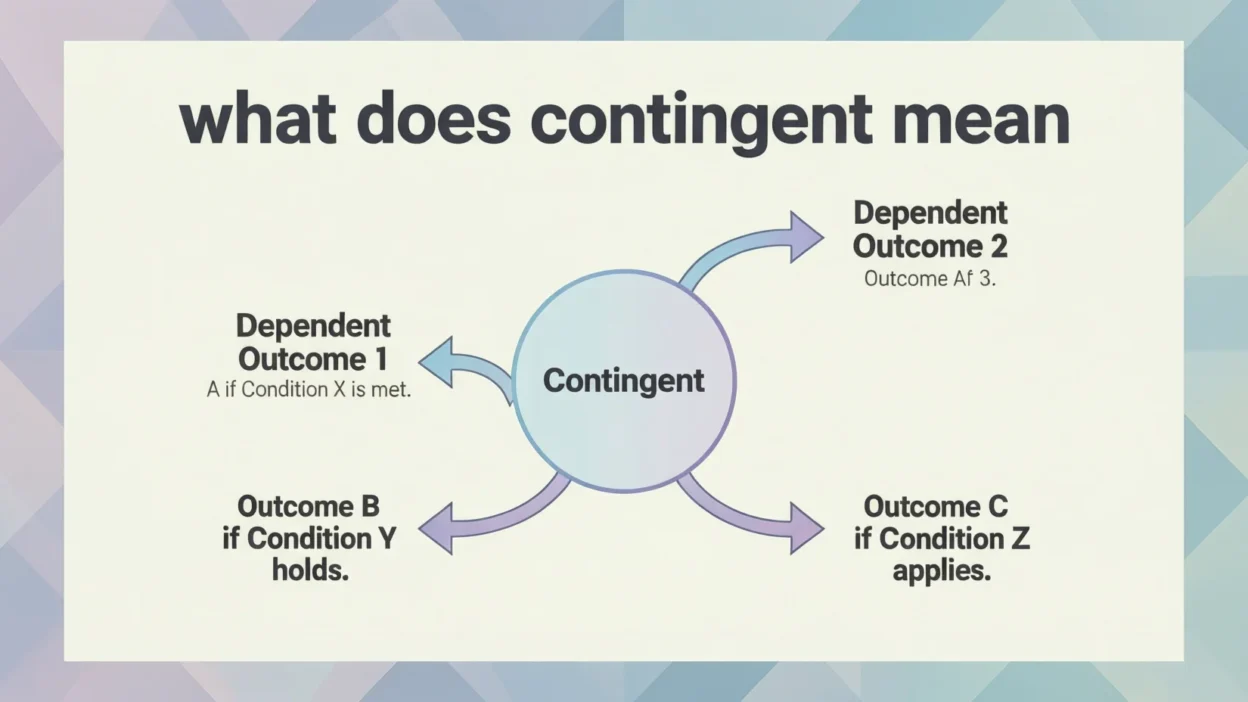
Contingent means “dependent on something else” or “conditional on certain circumstances.”
What Does Contingent Mean in Plain English?
Full form:
Contingent is not an abbreviation; it’s a single word from Latin contingere, meaning “to touch or happen.”
Plain-English meaning:
When something is contingent, it happens only if a certain condition is met. It’s a way of saying “it depends on something else.”
Why people use it:
- To show that plans are conditional
- To explain agreements or deals
- To clarify that outcomes aren’t guaranteed
- To indicate dependency in formal or casual communication
Example sentence:
“Our trip is contingent on everyone being available next weekend.”
Bold summary:
Contingent means something depends on certain conditions or circumstances and isn’t guaranteed.
Where Is “Contingent” Commonly Used?
Contingent is used in both formal and informal contexts, though it’s more common in professional or academic language.
Common places:
- Work emails: “The promotion is contingent on performance reviews.”
- Contracts & legal documents: “Payment is contingent upon delivery.”
- Social plans: “The picnic is contingent on the rain stopping.”
- News articles: “The deal is contingent on regulatory approval.”
- Business discussions: “Hiring is contingent on background checks.”
Tone:
- Formal: contracts, business, legal, professional writing
- Casual: texting, planning events, social conversations
Realistic Conversation Examples (Text Style)
Here are natural chat-style examples using contingent:
- “our movie night is contingent on everyone finishing work early”
- “the barbecue is contingent on the weather”
- “payment is contingent on delivery being confirmed”
- “our weekend hike is contingent on my car being fixed”
- “the meeting is contingent on the manager’s approval”
- “getting tickets is contingent on availability”
- “the event is contingent on enough people RSVPing”
- “contingent on your answer, i’ll book the table”
When to Use and When Not to Use “Contingent”
✅ Do Use Contingent When:
- describing plans that depend on something
- writing formal emails or documents
- explaining agreements or conditions
- clarifying uncertainty
❌ Don’t Use Contingent When:
- making casual statements like “i’ll eat pizza”
- in slang or informal social media posts without context
- when the situation is definite or guaranteed
Small Comparison Table
| Context | Example Phrase | Why It Works / Doesn’t Work |
|---|---|---|
| “approval contingent on review” | professional and clear | |
| social plan | “picnic contingent on sun” | casual, correct |
| casual chat | “i’ll come, contingent” | incomplete, awkward |
| text | “we’re going out contingent” | works if context is clear |
| command | “do it contingent” | incorrect usage |
Similar Words or Alternatives to Contingent
| Word | Meaning | When to Use |
|---|---|---|
| Conditional | depends on a condition | formal or casual |
| Dependent | relies on something else | general, simple |
| Provisional | temporary or subject to change | formal, agreements |
| Subject to | governed by a condition | contracts, legal writing |
| Based on | relies on something | informal, clear |
| Tentative | not final, may change | plans, scheduling |
All these words convey dependency or uncertainty.
FAQs About “What Does Contingent Mean?”
1. Is contingent formal or casual?
It can be both, but it’s most common in formal writing or professional settings.
2. Can contingent be used for people?
Yes. Example: “a contingent of students attended the event.” Here, it means a group or subgroup.
3. Is contingent the same as conditional?
Yes, in most cases, contingent = conditional, meaning depends on something else.
4. Can contingent be used in texting?
Yes, but it’s usually used with clarifying plans, like “our trip is contingent on rain stopping.”
5. Can contingent mean “maybe”?
Indirectly. It implies maybe, but only if a condition is met.
6. Are there synonyms for contingent?
Yes: conditional, dependent, provisional, subject to, tentative, based on.
7. Does contingent always imply uncertainty?
Yes. It signals that the outcome is not guaranteed and depends on circumstances.
Final Thoughts
So, what does contingent mean?
It means dependent on certain conditions or circumstances.
Whether in formal contracts, work emails, or casual plans, using the word contingent helps clarify that something isn’t guaranteed and relies on another factor.
Understanding contingent makes your communication precise and professional, whether in text messages, social media, or official writing.