Introduction
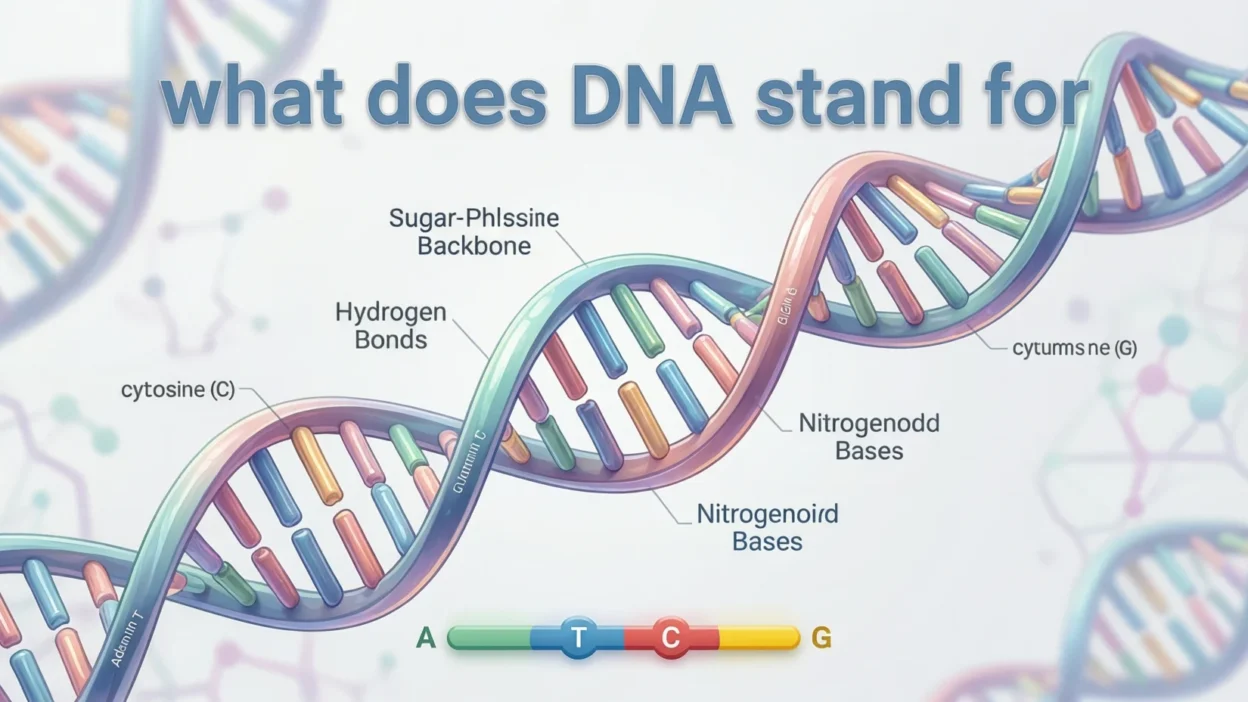
The first time I remember seeing DNA, it was in a school textbook with a colorful twisted ladder image.
Later, I started hearing it everywhere—crime shows, health articles, ancestry tests, and even memes online. People talked about DNA like everyone automatically knew what it meant.
But at some point, most of us stop and wonder, wait… what does dna stand for anyway?
If you’ve ever been curious about the letters behind this powerful term, you’re in the right place. Let’s explain it in the clearest, simplest way possible.
Quick Answer
DNA stands for Deoxyribonucleic Acid, the molecule that carries genetic information in living things.
What Does DNA Stand For and Mean?
DNA stands for Deoxyribonucleic Acid.
That sounds complicated, but the idea behind it is actually simple.
Plain-English Explanation
DNA is like a set of instructions inside your body.
These instructions tell your cells:
- how to grow
- how to function
- what traits you have
Everything from your eye color to your height is influenced by DNA.
Why DNA Matters
DNA is what makes you unique.
It controls how your body is built and how it keeps itself running.
Simple Example
- your dna helps decide your hair color and eye color
Bold summary: DNA stands for Deoxyribonucleic Acid and holds the instructions that make each living thing unique.
What Does DNA Do in the Body?
DNA works inside almost every cell in your body.
Key Roles of DNA
- stores genetic information
- guides cell growth and repair
- passes traits from parents to children
- helps your body function properly
Without DNA, cells wouldn’t know what to do.
Where Is DNA Found?
DNA is found inside cells, mainly in a part called the nucleus.
Where You’ll Find DNA
- humans
- animals
- plants
- bacteria
Anything living has DNA or a DNA-like genetic material.
Why Do People Talk About DNA So Much?
DNA shows up in many areas of life, not just science class.
Common Places You Hear About DNA
- medical tests
- crime investigations
- ancestry and family history
- health and genetics articles
- movies and TV shows
That’s why the term feels so familiar, even if the science sounds complex.
DNA in Everyday Conversation: Realistic Examples
Here are simple, natural examples of how people mention DNA:
- it’s in your dna to be creative
- they matched the dna from the scene
- dna tests can show ancestry
- that talent runs in the family dna
- science says dna affects traits
- siblings share similar dna
- your dna is unique to you
These examples show how DNA is often used both scientifically and casually.
DNA vs Genes: What’s the Difference?
People often mix these up.
Simple Breakdown
- DNA is the full instruction book
- genes are small sections of DNA
- genes control specific traits
Comparison Table
| Term | What It Means | Why It Matters |
|---|---|---|
| DNA | full genetic code | stores all instructions |
| genes | parts of DNA | control traits |
| chromosomes | DNA packages | organize DNA |
Is DNA the Same for Everyone?
No.
Humans share a lot of DNA, but no two people (except identical twins) have the exact same DNA.
That’s why DNA is used for:
- identification
- family matching
- solving crimes
When DNA Is Used (and When It’s Not)
✅ When DNA Is Used
- medical research
- health testing
- ancestry tracing
- forensic science
❌ When DNA Isn’t Used
- casual opinions
- personality guesses
- everyday decisions
Context Comparison Table
| Context | Example | Why It Fits or Doesn’t |
|---|---|---|
| medical test | dna screening | accurate use |
| crime show | dna match | correct |
| casual talk | “it’s in my dna” | metaphorical |
| guessing behavior | dna made me do it | not literal |
Similar Terms Related to DNA
Here are common terms people connect with DNA.
| Term | Meaning | When You’ll See It |
|---|---|---|
| genes | DNA segments | traits |
| genetics | study of DNA | science |
| chromosomes | DNA structures | biology |
| genome | complete DNA set | research |
| heredity | passing traits | family traits |
These terms all relate to how DNA works.
FAQs About What Does DNA Stand For
1. What does DNA stand for exactly?
Deoxyribonucleic Acid.
2. Is DNA only found in humans?
No, all living things have DNA.
3. What does DNA do in simple terms?
It carries instructions for how your body works.
4. Can DNA change?
It usually stays the same, but small changes can happen over time.
5. Is DNA the same as genes?
No. Genes are parts of DNA.
6. Why is DNA important in medicine?
It helps understand health, disease, and treatment.
7. Can DNA be seen with the eye?
No, it’s microscopic and seen with special tools.
Final Thought
So, what does DNA stand for? It stands for Deoxyribonucleic Acid, the instruction code that shapes every living thing.
While the name sounds complex, its role is simple and powerful—it tells your body how to grow, function, and stay unique.
Understanding DNA helps make sense of health, science, and even everyday conversations in the modern world.