The first time I saw “i.e.” in a message, I honestly paused and reread the sentence twice. A friend texted, “bring snacks, i.e., chips and cookies,” and I wondered if it was some new texting abbreviation.
Later, I noticed it everywhere — in emails, captions, school notes, and even social media comments. Some people use it to clarify their point, while others confuse it with “e.g.” or think it’s just internet slang.
If you’ve ever asked yourself what does ie mean, you’re definitely not alone. Let’s break it down in a super simple way so you can understand it fast and use it confidently in everyday texting and online chat.
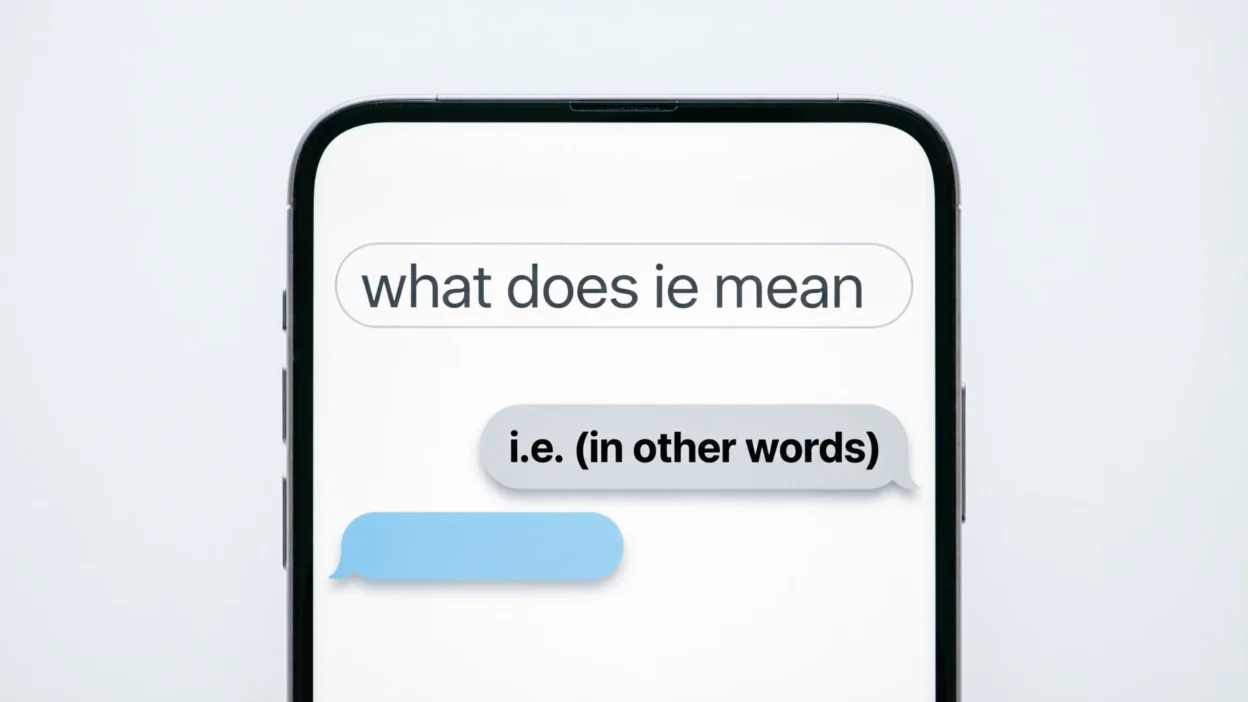
Quick Answer: “i.e.” means “that is” or “in other words,” and it is used to explain or clarify something more clearly.
what does ie mean in text and online chat?
In texting culture and everyday writing, “i.e.” is not exactly modern social media slang — it’s actually a traditional abbreviation that people still use in online chat meaning and digital communication.
Full form
i.e. comes from the Latin phrase id est, which means “that is” or “in other words.”
Plain-English explanation
When someone uses i.e., they are giving a clearer explanation or restating something so the reader understands exactly what they mean.
Why people use it
- to clarify a statement quickly
- to give a precise explanation
- to make messages shorter
- to sound clear and structured in texting or writing
Example sentence
“meet me at my favorite spot, i.e., the small café near the park.”
👉 Bold summary: “i.e.” means “in other words” and is used to explain or restate something more clearly in text and online communication.
where is “i.e.” commonly used?
Unlike many informal chat slang words, i.e. appears in both casual and slightly formal settings. That’s why people often search what does ie mean when they see it in mixed contexts.
Common places you’ll see it
- text messages and group chats: explaining details quickly
- emails and notes: adding clear definitions
- social media captions: clarifying posts
- school or work documents: structured explanations
- online forums and comments: providing precise meaning
Tone and style
- tone: neutral to semi-formal
- can work in casual texting but also professional writing
- more structured than typical social media slang
Because it’s not pure slang, it fits both informal chat and organized communication.
realistic conversation examples using “i.e.”
Here are natural lowercase examples showing how i.e. works in modern texting culture and online chat:
- “let’s watch something funny, i.e., a comedy movie.”
- “bring warm clothes, i.e., jackets and hoodies.”
- “i like simple games, i.e., puzzle games.”
- “meet at my house, i.e., the blue one near the shop.”
- “i’m on a break, i.e., not working today.”
- “we need healthy snacks, i.e., fruits or nuts.”
- “i’m avoiding sugar, i.e., no soda for me.”
- “choose easy levels, i.e., beginner mode.”
- “i want calm music, i.e., lo-fi or chill songs.”
These examples show how chat shorthand can make explanations clearer without long sentences.
when to use and when not to use “i.e.”
Understanding what does ie mean is only half the story — knowing when to use it matters just as much.
✅ do use “i.e.” when:
- you want to explain something clearly
- restating an idea in simpler words
- giving exact clarification
- writing notes, captions, or instructions
- adding precision to messages
❌ don’t use “i.e.” when:
- listing examples (use “e.g.” instead)
- chatting with people who don’t know abbreviations
- overusing it in casual slang-heavy chats
- trying to sound trendy or funny slang-wise
- replacing normal explanations in serious talks
small comparison table
| context | example phrase | why it works or not |
|---|---|---|
| group chat | “bring snacks, i.e., chips only” | clear clarification |
| school notes | “photosynthesis, i.e., plant food making” | precise explanation |
| example list | “fruits, i.e., apples and bananas” | wrong use — should be e.g. |
| meme comments | “this is i.e. funny lol” | unclear usage |
| work email | “submit forms, i.e., signed copies” | professional clarity |
This helps you avoid common mistakes in texting abbreviation use.
similar terms and alternatives to “i.e.”
If you’re learning what does ie mean, it helps to understand related chat shorthand and writing abbreviations too.
| term | meaning | when to use |
|---|---|---|
| e.g. | for example | listing sample items |
| aka | also known as | giving another name |
| in other words | explanation phrase | casual conversations |
| that is | direct clarification | formal or neutral tone |
| meaning | simple explanation | everyday texting |
| basically | simplified explanation | informal chat |
| aka | nickname or alternative name | social media or gaming |
quick tip
Use i.e. when you want to define something exactly, and use e.g. when giving examples.
frequently asked questions about “what does ie mean”
1. what does ie mean in texting?
It means “in other words” and is used to clarify or explain something more clearly.
2. is “i.e.” slang or formal writing?
It’s actually a traditional abbreviation, but it can appear in both casual texting and semi-formal communication.
3. what is the difference between i.e. and e.g.?
i.e. explains exactly what you mean, while e.g. gives examples.
4. is it okay to use “i.e.” on social media?
Yes, especially in captions, comments, or explanations where you want to clarify something quickly.
5. do young people use “i.e.” often?
Some do, especially in school chats or informative posts, but it’s less trendy than modern social media slang.
6. can “i.e.” be used in professional emails?
Yes. It’s widely accepted in work communication when explaining details clearly.
7. is “i.e.” always followed by a comma?
Usually yes, especially in formal writing, but casual texting may skip punctuation.
final thought
So, what does ie mean? Simply put, it means “in other words” or “that is,” and it helps clarify a message quickly and clearly. Unlike many social media slang terms, i.e. works in both informal chat and more structured communication like emails or notes.
Knowing how to use it properly can make your messages easier to understand and more precise. Just remember — use it when you’re explaining something exactly, not when giving examples. Mastering small abbreviations like this makes a big difference in modern digital communication and everyday texting culture.