Introduction
Most people first hear the word perpendicular in school, usually during a math or geometry class.
The teacher draws two lines on the board, they meet at a perfect corner, and suddenly this big word appears. Later on, you might see it again in a DIY video, a design post, or even in casual explanations online.
And every time, the same question pops up: “okay… but what does perpendicular actually mean?”
Good news — it’s much simpler than it sounds. Let’s break it down in a clear, easy, and relatable way.
Quick Answer:
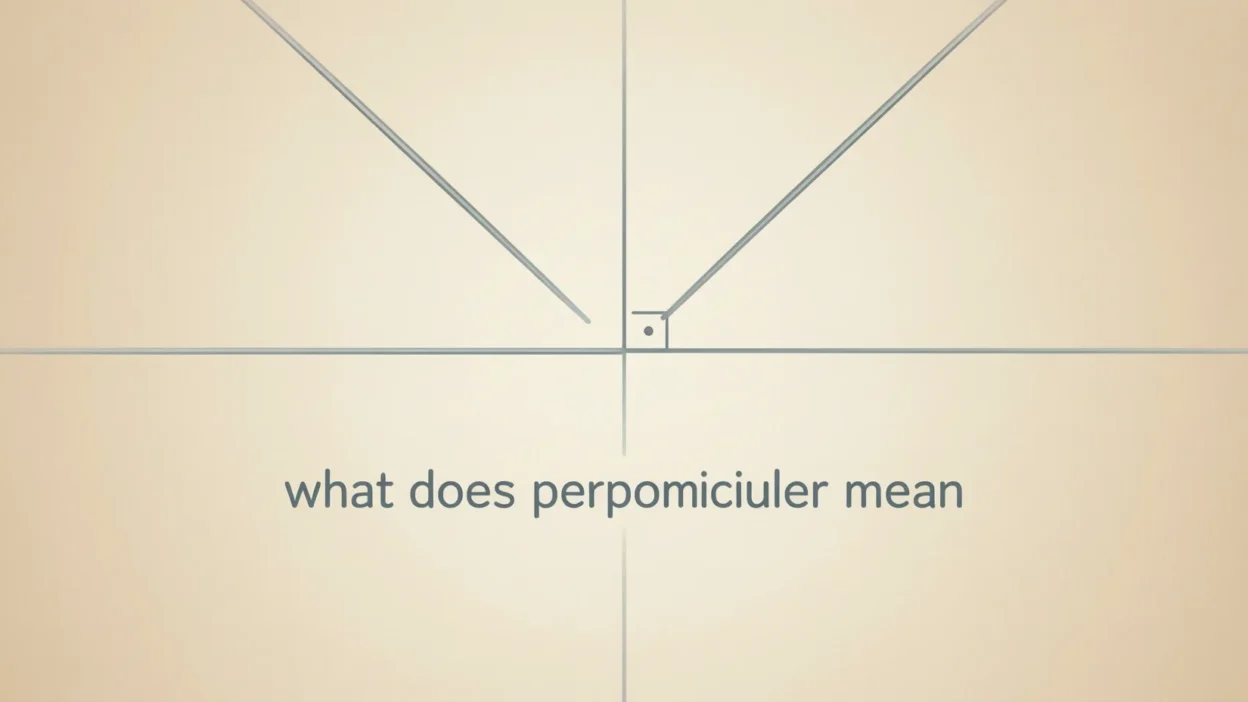
Perpendicular means two lines or objects meet at a right angle (90 degrees).
What Does Perpendicular Mean? (Plain-English Explanation)
Full meaning
The word perpendicular comes from Latin roots meaning “to hang straight down.”
Simple explanation
In everyday language:
Think of the letter L or the corner of a book. That’s perpendicular.
Why people use the word
- to describe angles clearly
- to explain layouts or directions
- to sound precise in math, design, or construction
One short example sentence
- the two roads are perpendicular to each other.
Bold summary:
Perpendicular means meeting at a right angle (90°).
Where Is the Term Perpendicular Commonly Used?
You’ll see perpendicular in many practical situations.
Common places it’s used
- math and geometry
- architecture and construction
- engineering and design
- maps and directions
- school textbooks
- educational videos
Tone and formality
- tone: neutral
- formality: educational or professional
- not slang, but very common
It’s widely understood and used correctly in both school and real-life explanations.
Perpendicular in Math (Very Simple)
This is the most common use.
In geometry
Two lines are perpendicular if:
- they cross each other
- the angle between them is exactly 90 degrees
Easy visual examples
- the x-axis and y-axis on a graph
- the corner of a square
- vertical and horizontal lines crossing
Symbol used in math
You might see it written as:
- ⊥ (means “is perpendicular to”)
Math summary:
Perpendicular lines always form a right angle.
Realistic Conversation Examples (Modern Style)
Here are 8 natural examples, written in lowercase like real conversations:
- make sure those lines are perpendicular
- the shelf isn’t perpendicular to the wall
- draw a perpendicular line from the point
- the streets cross perpendicular here
- the table legs need to be perpendicular
- the angle looks off, it’s not perpendicular
- the design uses perpendicular patterns
- that diagram shows perpendicular lines clearly
When to Use and When NOT to Use Perpendicular
✅ When to use perpendicular
- talking about angles
- describing layouts or shapes
- explaining math problems
- construction or design instructions
❌ When not to use perpendicular
- casual emotional conversations
- slang or joking contexts
- when you simply mean “near” or “close”
Quick comparison table
| Context | Example Phrase | Why It Works / Doesn’t |
|---|---|---|
| math class | these lines are perpendicular | correct usage |
| diy project | keep the board perpendicular | clear instruction |
| casual chat | our ideas are perpendicular | confusing |
| essay | walls are perpendicular | precise and correct |
Similar Words or Related Terms
Here are useful related terms to know:
| Term | Meaning | When to Use |
|---|---|---|
| right angle | 90-degree angle | basic explanations |
| vertical | straight up and down | directions |
| horizontal | flat, side to side | layouts |
| parallel | lines that never meet | contrast with perpendicular |
| intersecting | lines that cross | general description |
Tip:
If two lines never meet, they’re parallel — not perpendicular.
Common Misunderstandings About Perpendicular
- perpendicular ≠ parallel
- perpendicular ≠ diagonal
- perpendicular is always 90 degrees, not close to it
- it’s about angles, not distance
Clearing this up helps avoid common math mistakes.
FAQs About Perpendicular
1. what does perpendicular mean in simple words?
It means crossing at a right angle (90 degrees).
2. is perpendicular only used in math?
No — it’s also used in design, construction, and directions.
3. what’s an example of perpendicular in real life?
The corner of a room or a crossroad intersection.
4. what’s the opposite of perpendicular?
Parallel (lines that never meet).
5. can more than two lines be perpendicular?
Yes, multiple lines can be perpendicular to the same line.
6. is perpendicular a formal word?
It’s neutral — common in education and professional use.
Final Thoughts
So, what does perpendicular mean? It simply means meeting at a perfect right angle. Whether you’re solving a math problem, building something, or reading a diagram, understanding perpendicular helps you see how things line up correctly.
Once you picture that clean 90-degree corner, the word becomes easy — and useful.