Have you ever been scrolling through social media or reading a news article and seen the word “queer”, leaving you unsure what it truly means?
I remember the first time I saw it in a friend’s post—they wrote, “Feeling proud to be queer!”—and I paused, thinking, “Wait… what exactly does queer mean?” Over time, I learned that queer is a broad, inclusive term used to describe sexual orientation and gender identity.
If you’ve ever wondered what queer means, this guide will explain it in a simple, clear, and friendly way.
Quick Answer:
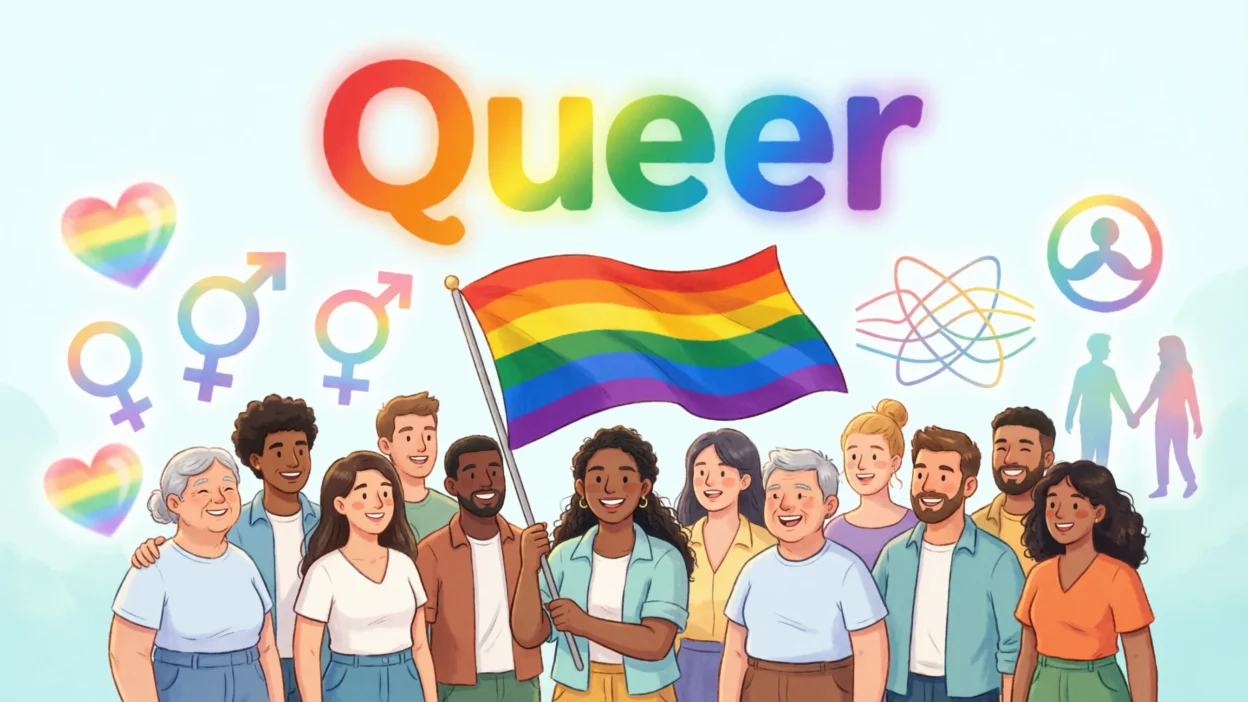
Queer is an umbrella term for sexual and gender identities that are not exclusively heterosexual or cisgender.
What Queer Means
Queer is a term used to describe people whose sexual orientation, gender identity, or expression falls outside traditional heterosexual or cisgender norms. It’s an inclusive, flexible word that has been reclaimed by the LGBTQ+ community as a positive identifier, even though it was once used as a slur.
Why people use it:
- To describe themselves without specifying a particular label.
- To embrace inclusivity for all non-heterosexual or non-cisgender identities.
- To create space for fluid, diverse sexualities and genders.
Example Sentence:
- “they identify as queer and prefer using they/them pronouns”
In short: Queer is a broad term for anyone whose sexuality or gender identity does not fit traditional norms.
Where the Term is Commonly Used
Queer is widely used in social, educational, and activist contexts, including:
- Social media: Posts, hashtags, and profiles celebrating LGBTQ+ identities.
- Texting and chats: Friends discussing identity, pronouns, or relationships.
- LGBTQ+ communities: Support groups, forums, and pride events.
- Media and journalism: Reporting on queer culture, rights, and representation.
- Academic discussions: Gender studies, queer theory, and sociology.
The tone is generally inclusive, affirming, and respectful. Context matters: it’s positive when self-identified but may be offensive if used as a slur by outsiders.
7 Realistic Conversation Examples
Here are natural texting-style examples using queer:
- “hey, wsg? i just came out as queer to my friends”
- “they identify as queer and love being part of the community”
- “i’m queer and proud of my identity”
- “that movie had a great queer character”
- “wsg? exploring queer literature this weekend”
- “attending the queer pride parade this saturday”
- “my queer friend gave amazing advice on relationships”
- “they use queer as their identity label”
- “queer spaces online are so supportive and welcoming”
These examples reflect real-life, affirming conversations in both casual and social media contexts.
When to Use and When Not to Use the Term
✅ When to Use Queer
- Talking about your own LGBTQ+ identity.
- Discussing LGBTQ+ culture, media, or representation.
- Referring to inclusive communities or safe spaces.
- Supporting or affirming someone else’s identity.
❌ When Not to Use Queer
- As a slur or insult—it can be offensive in that context.
- To label someone without their consent.
- In formal professional or non-LGBTQ+ discussions unless contextually relevant.
| Context | Example Phrase | Why It Works / Doesn’t Work |
|---|---|---|
| Personal identity chat | “i’m queer and proud” | Works – affirming and self-identified |
| Social media post | “queer representation matters” | Works – inclusive and positive |
| Random insult | “that’s so queer lol” | Doesn’t work – offensive and disrespectful |
| Educational discussion | “queer theory explores gender” | Works – academic and accurate |
Similar Terms or Related Concepts
| Term | Meaning | When to Use |
|---|---|---|
| LGBTQ+ | Lesbian, Gay, Bisexual, Transgender, Queer/Questioning, plus others | Formal or general reference to the community |
| Pansexual | Attracted to people regardless of gender | Specific sexual orientation |
| Non-binary | Gender identity outside male/female | Talking about gender identity |
| Genderqueer | Non-traditional gender expression | Inclusive gender identity discussion |
| Gay / Lesbian / Bisexual | Specific sexual orientations | When precise identity is shared |
These terms often overlap with queer, which is intentionally broad and flexible.
FAQs About Queer
1. Can anyone use the word queer?
It’s safest used by those identifying as queer or in supportive, respectful contexts.
2. Is queer a slur?
Historically, yes, but it has been reclaimed as a positive, inclusive term by the LGBTQ+ community.
3. Can queer describe both sexuality and gender?
Yes, it’s used for both sexual orientation and gender identity.
4. How is queer different from LGBTQ+?
LGBTQ+ is an acronym for specific identities, while queer is a broad, umbrella term.
5. Can someone identify as queer even if they are straight?
Typically, queer is used by those whose identity is not exclusively heterosexual or cisgender.
6. Is queer recognized in academic contexts?
Yes, in queer studies, gender studies, and sociology, it’s a standard term.
7. Can queer be used in casual conversation?
Yes, as long as it’s respectful and affirming of identities.
Final Thought
Queer is a powerful, inclusive word that celebrates diversity in sexual orientation and gender identity.
Understanding its meaning helps you communicate respectfully, support LGBTQ+ communities, and embrace modern identity language. Whether used in casual chats, social media, or academic discussions, knowing what queer means encourages awareness, inclusivity, and acceptance.