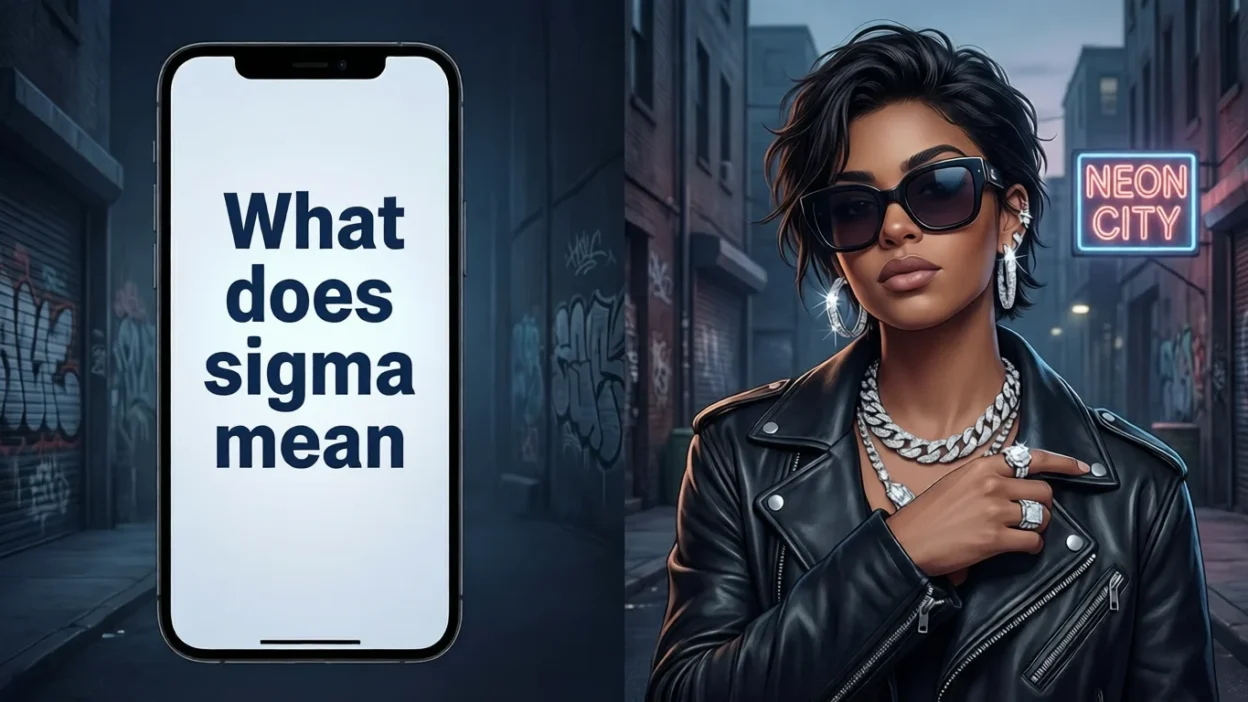
You’re scrolling through TikTok or Instagram, watching reels or reading comments, when you keep seeing the word “sigma.” Someone says, “he’s a real sigma,” or a video caption reads, “sigma mindset.”
Everyone seems to agree it’s a compliment—but what does it actually mean? At first, it sounds like a math term or a random Greek letter.
But online, sigma has taken on a whole new life. If you’ve ever felt confused seeing it pop up everywhere, you’re definitely not alone.
Let’s explain it clearly, simply, and without overthinking it.
Quick Answer:
Sigma means an independent, self-reliant person who doesn’t follow the crowd and succeeds quietly on their own terms.
What Does Sigma Mean in Text and Online Slang?
In modern internet slang, sigma usually refers to a “sigma male” or “sigma mindset.”
Full form (if applicable)
There’s no acronym here. Sigma comes from the Greek letter σ (sigma), but its slang meaning is completely cultural, not academic.
Plain-English meaning
When someone is called sigma, they are being described as:
- independent
- confident without showing off
- quiet but powerful
- not seeking attention or approval
- successful outside the social hierarchy
A sigma person doesn’t try to be the leader, but they still win.
Why do people use it?
People use sigma because it:
- sounds cool and mysterious
- fits meme culture
- represents quiet confidence
- contrasts with loud “alpha” behavior
Short example
Bold summary: Sigma means a person who is confident, independent, and successful without needing validation.
Sigma vs Alpha: What’s the Difference?
This comparison is a big reason sigma became popular.
- Alpha: loud, dominant, leader of the group
- Sigma: quiet, independent, doesn’t need a group
Sigmas don’t compete for attention. They operate alone and let results speak.
This idea spread heavily through memes, short videos, and motivational clips.
Where Is “Sigma” Commonly Used?
You’ll mostly see sigma in casual, informal online spaces.
Common platforms:
- tiktok (sigma edits, mindset videos)
- instagram reels
- youtube shorts
- meme pages
- gaming chats
- comment sections
Tone and vibe:
- tone: casual, humorous, sometimes motivational
- formality: informal
- emotion: admiration, hype, irony
Sometimes it’s serious. Sometimes it’s sarcastic. Context matters a lot.
Realistic Conversation Examples (Modern Usage)
Here are natural, lowercase examples that reflect real online chats:
- “bro ignored the drama and still won. sigma behavior”
- “he doesn’t talk much but always levels up. sigma”
- “that walk away was cold. sigma mindset”
- “no flex, no noise, just results. sigma”
- “everyone arguing, he stayed silent. sigma move”
- “lowkey rich, lowkey powerful. sigma”
- “that villain arc turned him sigma”
- “sigma energy fr”
- “not alpha, not beta. sigma.”
When to Use and When Not to Use “Sigma”
Like most internet slang, sigma works best in the right context.
✅ Do use “sigma” when:
- joking with friends
- reacting to memes
- describing independence or confidence
- commenting on social media
❌ Don’t use “sigma” when:
- writing formally
- talking to people unfamiliar with slang
- discussing serious psychology topics
- trying to insult someone (it’s not meant for that)
Comparison Table
| context | example phrase | why it works or not |
|---|---|---|
| meme comment | “sigma mindset” | fits humor |
| casual chat | “that was sigma” | slang-friendly |
| school essay | “sigma male theory” | informal |
| work email | “be sigma” | unprofessional |
Other Meanings of Sigma (Non-Slang)
While slang is the most popular meaning today, sigma has other definitions too.
Greek letter
In math and science, sigma (σ) is used to represent sums, standard deviation, or formulas.
Statistics
Sigma often refers to variation or deviation, like in “six sigma.”
Personality talk (older meaning)
Some people loosely use sigma as a personality type, but this is not scientific.
Online slang is not the same as academic sigma.
Similar Slang Words and Alternatives
Here are words often used in a similar way:
“alpha”
Dominant, loud leader type.
“lone wolf”
Someone who prefers being alone.
“main character”
Person acting like their life is a movie.
“cold”
Emotionally controlled, unbothered.
“unbothered”
Not affected by drama or opinions.
“villain arc”
Joking way to describe self-focused growth.
Each term overlaps, but sigma focuses most on quiet independence.
Common Misunderstandings About Sigma
People often think:
- sigma is a real personality category
- sigma means antisocial
- sigma is always serious
- sigma is better than everyone
In reality
- it’s mostly internet culture
- often used humorously
- sometimes ironic or exaggerated
Not every “sigma” post is meant to be taken literally.
FAQs About “What Does Sigma Mean”
1. What does sigma mean in slang?
It means independent, confident, and self-reliant, often quiet but powerful.
2. Is sigma a compliment?
Usually yes. It’s meant as praise or admiration.
3. Is sigma real psychology?
No. It’s an internet-created concept, not scientific.
4. Can women be sigma?
Yes. While often used for men, anyone can be called sigma.
5. Is sigma serious or a joke?
Both. It can be motivational or purely meme-based.
6. Is sigma better than alpha?
Not better—just different styles of confidence.
Final Thought
So, what does sigma mean today? In online slang, it represents quiet confidence, independence, and success without attention. It’s a product of meme culture, social media, and modern attitudes toward individuality.
Sometimes it’s serious. Sometimes it’s ironic. But either way, understanding sigma helps you stay in tune with current internet language—and avoid feeling lost in comment sections.